
Thursday, June 20, 2013


Wednesday, June 19, 2013
FOCP to Attend the Third Global Breast Health Lecture Series, Abu Dhabi, June 23rd, 2013
FOCP has been invited to
speak about "The Role of Non Governmental Organizations" in enhancing
early detection and treatment for breast cancer, at the 3rd Global Breast
Health Lecture Series organized by Mafraq hospital.
The event is targeted at health
care givers and any staff working in breast care, so if you are
interested to join check the agenda below for more information and RSVP to Normy Acosta nacosta@mafraqhospital.ae
تلقت
جمعية أصدقاء مرضى السرطان الدعوة للتحدث عن دور المؤسسات الغير حكومية في تعزيز الاكتشاف
المبكر والعلاج لسرطان الثدي، وذلك من خلال سلسلة محاضرات صحة الثدي العالمية الثالثة
والتي تنظمها مستشفى المفرق.
ويستهدف
هذا الحدث مقدمي الرعاية الصحية وأي من العاملين في مجال رعاية سرطان الثدي، وللمهتمين
بحضور المحاضرات يمكنكم التحقق من جدول الأعمال أدناه للحصول على مزيد من المعلومات وللحجز يمكنكم الإتصال بـ نورمي أكوستا


Tuesday, June 18, 2013
Cancer society looks for regulation of e-cigarettes | Irish Examiner
The Irish Cancer Society says it cannot recommend electronic cigarettes as an alternative to tobacco until they are regulated in Ireland.

 By Evelyn Ring
Irish Examiner Reporter
Manufacturers will have to face tough tests before they can sell their e-cigarettes as ‘licensed products’ in Britain.
The move will also mean e-cigarettes can be prescribed by doctors in to help smokers cut down or quit.
An e-cigarette is an electronic inhaler that vaporises a liquid nicotine into an aerosol mist, simulating the act of tobacco smoking
However, an ICS spokeswoman said the body could not recommend e-cigarettes in the absence of appropriate regulation and evidence.
“Until the safety and efficacy of these products are established and we can be assured that they do not pose a hazard to a person’s health and well-being, we are unable to recommend them,” said the spokeswoman.
E-cigarettes are widely available in Ireland but there are no regulations setting down the provisions for their sale or advertising.
The Pharmaceutical Society of Ireland advised pharmacies two years ago that, in the absence of regulation, e-cigarettes should not be offered for sale in pharmacies. E-cigarettes are being offered for sale in Ireland in a wide variety of shops and online, and a number of people have claimed to have quit smoking since using them.
In December, the European Commission proposed an EU tobacco products directive, the aim of which is to reduce the numbers smoking.
The proposal, currently being considered by member states, recommends that nicotine containing products below a certain nicotine threshold, such as e-cigarettes, are allowed on the market but must feature health warnings.
A spokesman for the Department of Health said the proposal was being discussed in the European Parliament and Council of Ministers and the commission was hoping it would be adopted next year.
He said the Irish presidency was using its time as chair of the council of the EU to vigorously pursue measure to reduce the prevalence of smoking, particularly among young people.
The Irish Medicines Board taking part in the European discussions said e-cigarettes were not regulated under medicines or medical devices legislation unless they make medicinal claims.
Currently products that are presented for use in or to assist in smoking cessation, such as patches and gum, are regarded to be medicines and must be authorised by the IMB before being sold in Ireland.
© Irish Examiner Ltd. All rights reserved
'via Blog this'
Friday, June 14, 2013
Is the use of face-to-face fundraising worth the reputational risk? | Voluntary Sector Network | Guardian Professional
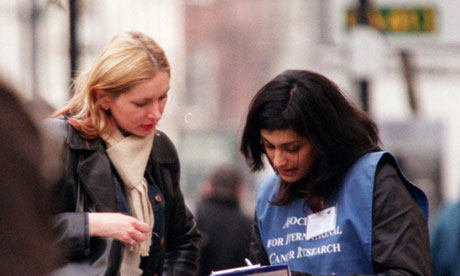 |
| Street fundraising has become increasingly unpopular but is not the only method complained about. Photograph: Andy Hall |
Attitudes to fundraising frequently divide both the charitable sector and the public. If it's not the admin costs, it's the fact that fundraisers are paid for the volume of appeals. And nothing quite raises the heckles like face-to-face fundraising (F2F).
The Directory of Social Change's recent poll on F2F is a case in point, with 70% of the 293 respondents believing it to be "appalling and damaging". Of the survey's 96 written comments, much of the ill-feeling focused on "paid canvassers", many of whom are "young with no knowledge of the cause", who "browbeat" the public and give charities "a bad name".
Objections to F2F also make regular appearances in newspaper op-eds, blogs and on Twitter, with people grumbling about "aggressive behaviour" and how they can't walk down a street without being asked 20 times. Criticism of direct mail is less vocal, but no less important. Indeed, DM receives the most official complaints of all the fundraising techniques used, generating 14,903 in 2011, according to the Fundraising Standards Board (FRSB). These complaints tend to focus on the frequency of appeals and poor use of data.
Many people believe charities should stop using these techniques before they irreversibly blacken the name of the sector. But is the use of controversial techniques worth the reputational risk? And what, if anything, can be done to improve perceptions?
First, it's important to put criticism of F2F and DM into context. DM may have received almost 15,000 complaints in 2011, but with more than 172m mailings sent these equate to just 0.009% of the volume. The same applies to F2F. Doorstep fundraising received 2,877 complaints(0.145% of volume) while street fundraising received 1,098 complaints (0.003% of volume). Indeed, while the profile of "chugging" may give the perception that it's the most complained-about mechanism, it actually features among eight means of raising cash, including beloved raffles.
Equally, when compared to corporates charities perform well, says Mike Lordan, operations chief at the Direct Marketing Association. "We run theMailing Preference Service. There are very few charity complaints. I don't see this as a crisis."
Not only that but these tools raise many millions of pounds each year, argues Mark Astarita, director of fundraising at the British Red Cross and chair of the Institute of Fundraising. To stop using them would have a catastrophic effect. "The sector would lose billions and millions of people would not get help as a result. Society has a choice. To stop us from asking nicely means ignoring the plight of many," he says.
A fair and important point. But how do the experiences of those people who don't like these techniques impact on giving levels? DM may raise millions of pounds from the 1.5% who respond to cold appeals, but what about the other 98.5%? F2F may raise millions from the people who sign up. But what about those who were asked and said no? Could it be that more money could be raised if only people were asked in a more appropriate way?
We know from research by CAF that the proportion of people donating to charitable causes in a typical month has decreased over the last year, from 58% to 55%. In addition, the estimated total donated in 2011/12 was £9.3bn, a decrease of £2.3bn in real terms. How much of this is down to the economy and how much is the result of poor fundraising? There is little research readily available to help answer this question. In 2012,Adrian Sargeant published a paper on Donor Complaints about Fundraising but this looked more at the incidence of complaints rather than the impact of dissatisfaction on attitudes to charity. Instead, the study turned to levels of public trust for clues. But even this was unclear.
A recent Ipsos MORI report showed confidence remains high. However, the same survey also found fundraising becoming increasingly unpopular, with 67% of people saying some methods, such as street and telephone, "make them feel uncomfortable", an increase from 60% in 2010. With the exception of a line that said "a negative experience can make someone less willing to donate to that charity", no further insight into what impact this had on giving levels was offered.
"Research into attitudes and irritations would be helpful," agrees Alistair McLean, chief executive of the FRSB. "What one person thinks is aggressive another will think is ok. To cross-reference this with age could help charities get the balance right when they are making approaches."
In his view, however, this is not about stopping using particular tools, but about education, starting within charities themselves: "There would be great merit in those people who sit outside the fundraising community understanding more about how all fundraising works," he says.
This opinion is reiterated by others, including Martin Jervis, chief executive of Fundraising Initiatives, a F2F agency. "This is fundamentally a leadership issue. Fundraisers need to educate their executive teams. There needs to be more on fundraising at trustee conferences. There are not enough conversations between fundraisers and trustees. This would help convince people that these types of fundraising are well managed."
The PFRA provides an example of how leadership can have a positive impact. It has recruited some of its member charities to advocate for F2F with the press. "We've persuaded charities to come and be confident on the fundraising they do. It has helped change attitudes," says its head of communications, Ian McQuillan.
More advocacy combined with research into how experiences of fundraising impacts on propensity to give could go a long way towards both satisfying the critics and strengthening confidence across the board. As the FRSB's McClean says: "The public's high level of trust is a privilege not a right. Charities need to work hard on all fronts to protect the reputation they enjoy."
This content is brought to you by Guardian Professional. To join the voluntary sector network, click here.
'via Blog this'Monday, June 10, 2013
WAM | Nahyan bin Mubarak receives AED1.1 million donation for "Friends of Cancer Patients Charitable Society"
Sheikh Nahyan bin Mubarak Al Nahyan, Minister of Culture, Youth and Community Development, has received a AED 1.1 million donation for ''The Friends of Cancer Patients Charitable Society" in Sharjah, which is the culmination of fund raising from the Oil Barons Charity Ball at Meydan racecourse which was held in Dubai.
Sheikh Nayan received the cheque in his capacity as honorary chairman of the Society, in the light of the initiative which aims to embody solidarity and boost the spirit of social interaction with families of patients in addition to supporting its initiatives pertaining to cancer disease, including covering the expenses of medical treatment inside or outside the country.
Sheikh Nahyan hailed the increasing support, assigned by the Oil Barons and their permanent commitment, to contribute to achieving the objectives and the noble desires.
He also commended the Society's Board of directors for their support to the patients.
WAM/HH/CM
Friday, June 7, 2013
International expert panel on inflammatory breast cancer
From www.ncbi.nlm.nih.gov - Today, 5:24 AM
"
 Inflammatory breast cancer (IBC) represents the most aggressive presentation of breast cancer. Women diagnosed with IBC typically have a poorer prognosis compared with those diagnosed with non-IBC tumors. Recommendations and guidelines published to date on the diagnosis, management, and follow-up of women with breast cancer have focused primarily on non-IBC tumors. Establishing a minimum standard for clinical diagnosis and treatment of IBC is needed."
Susan Zager's insight:
'via Blog this'
"
Susan Zager's insight:
It took until 2011 for them to come out with what Inflammatory Breast Cancer (IBC) is. IBC is so agressive and won't show up on a mammogram. It is often diagnosed as a skin infection and is so dangerous because it grows so fast. It is usually found at a late stage, burns when someone has it radiated and usually can't be reconstructed."
'via Blog this'
Tuesday, June 4, 2013
Pink Caravan’s data system gets a hi-tech makeover | GulfNews.com
Sharjah: The Pink Caravan initiative by the Friends of Cancer Patients organisation has developed a new method to record patient statistics during their annual national screening campaign.
The group, which raises awareness about breast cancer, used the new system for the first time during the Pink Caravan’s third annual horseback journey in the UAE.
The new documentation application involves the use of electronic tablets for easy patient registration, examination and record management and enables a high level of data accuracy as there is no need to transfer from paper to electronic. The programme includes dynamic survey capabilities and reliable post-survey analysis to measure the impact of the awareness drive.
“The patient record management programme, which forms phase I of the IT solution — has reduced the possibility of human error as it does not require an additional data capturer post campaign to transfer data and is helping to save precious time and keeping costs low,” said Dr Sawsan Al Madhi, secretary general for the FoCP and Head of the Pink Caravan’s Medical and Awareness committee.
Dr Sawsan said Phase II will use the same capability to include other types of cancers.
While the new system will ensure almost 100 per cent accurate data on the status of cancer in the country, Dr Sawsan said the UAE still lacks definitive and reliable information and statistics about the demographics and prevalence of cancer in the country. “The gathering of this information is crucial to the creation of effective and efficient treatment and cancer preventative programmes in the country and for the accurate allocation of resources,” she added.
'via Blog this'
Subscribe to:
Posts (Atom)